
Pet Diagnostic Services in Queen Creek, AZ
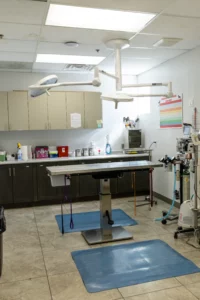
When your pet is sick, injured, or showing symptoms that are difficult to explain, getting clear answers quickly can make a major difference in what happens next. At Queen Creek Veterinary Clinic, we offer advanced diagnostic capabilities in one convenient location, including pet ultrasound, pet radiology, CT imaging, and pet lab services in Queen Creek. These tools help our veterinarians look beyond what can be seen during a physical exam and gather more detailed information about your pet’s internal health. Our goal is to make diagnostics more efficient, more precise, and easier for owners to understand throughout the process.
Advanced Diagnostics Without Sending You All Over Town
Diagnostic testing is often one of the most important parts of veterinary care because many illnesses can cause similar outward symptoms. Vomiting, lethargy, coughing, weight loss, pain, and appetite changes can point to several different conditions, which is why imaging and laboratory testing can be so valuable. Instead of relying on guesswork, we use advanced technology to help narrow down possible causes and make more informed treatment decisions.
Our diagnostic services include digital radiography, CT imaging, ultrasound, and in-house laboratory testing. Having these capabilities available in our clinic means many pets can receive testing, evaluation, and treatment planning in one place. When more specialized interpretation is needed, we can also work with outside experts, including board-certified radiologists, to help review advanced imaging cases.
Digital Pet Radiology for Fast, Detailed Imaging
Our clinic exclusively uses digital X-ray technology rather than traditional film radiography. We have specialized digital units designed for both the body and the mouth, which allow us to capture detailed images and review them almost immediately. Digital pet radiology also gives our veterinarians the ability to enlarge, manipulate, and closely examine areas of concern that may be more difficult to evaluate on conventional film.
Because the images are digital, our doctors can access them from computers throughout the hospital and show owners what they are seeing directly on a screen. This can make conversations about injuries, disease, and treatment options much easier to follow. If your pet needs a specialist consultation or referral, digital images can also be securely shared with you or the receiving veterinary hospital without waiting for physical films to be processed or transported.
CT Imaging for a Deeper Look Inside the Body
Some medical conditions require even more detail than a standard X-ray or ultrasound can provide. Our state-of-the-art CT machine creates three-dimensional images that allow us to examine internal structures from multiple angles and identify abnormalities that may otherwise be difficult to locate. This level of detail can be especially helpful when we are evaluating complex or hard-to-reach areas of the body.
CT imaging may be useful for concerns involving the brain, inner ear, sinuses, teeth, jaw, small tumors, cancer spread, and certain cases of Valley Fever. It can also provide important information when traditional imaging does not fully explain a pet’s symptoms. A board-certified radiologist is available to consult with our veterinary team on appropriate CT cases, giving us access to an additional level of expertise when interpretation becomes more complex.
We also include a CT of the jaws and teeth with every dental cleaning at no additional cost. This can help us identify bone loss and other dental abnormalities more quickly and accurately than standard dental X-rays alone in certain situations.
Pet Ultrasound for Real-Time Internal Imaging
A pet ultrasound gives us a different kind of information than an X-ray because it allows us to view many soft tissues and internal organs in real time. Ultrasound can help us assess organ shape, movement, blood flow, and internal structure, giving us valuable insight into how areas of the body may be functioning. It is especially useful when we need to investigate changes that may not appear clearly on radiographs.
We may recommend ultrasound when evaluating concerns such as:
- Internal masses or tumors
- Bladder stones or crystals
- Changes involving abdominal organs
- Certain reproductive concerns
- Canine or feline pregnancy
- Fetal counts during pregnancy
- Other soft tissue abnormalities
In most cases, ultrasound can be performed without general anesthesia, which helps keep the process relatively simple for many patients. And in some situations, mild sedation may be needed if a pet is too anxious or uncomfortable to remain still enough for us to obtain clear images.
In-House Pet Lab Services for Faster Answers
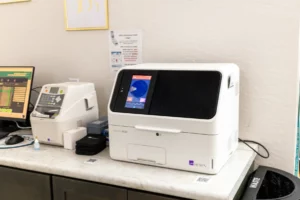
Imaging tells us a great deal about structure, but laboratory testing helps us understand what is happening at the cellular and biochemical level. Our full in-hospital laboratory allows us to perform a wide range of common tests without automatically sending every sample to an outside facility. That can be especially valuable for sick pets, emergency cases, and animals preparing for surgery because results may be available much sooner.
We routinely process blood chemistries and complete blood counts for both sick and pre-surgical patients. These tests can help us evaluate organ function, hydration, infection, anemia, inflammation, and other important health indicators. Having this information available quickly allows our veterinarians to make treatment and anesthesia decisions with a more complete understanding of the patient’s condition.
Tests We Can Perform While You Wait
Our pet lab services in Queen Creek also include several rapid tests for common infectious and regional diseases. Depending on your pet’s symptoms, travel history, age, and risk factors, we may recommend targeted testing to help identify or rule out specific conditions.
Our in-house capabilities include testing for:
- Heartworm disease
- Ehrlichia canis, also known as tick fever
- Anaplasmosis
- Lyme disease
- Feline leukemia
- Feline immunodeficiency virus
- Giardia
- Valley Fever
- Parvovirus
- Basic urinalysis
- Cytology
When a case requires more extensive or specialized analysis, we send samples to a trusted reference laboratory. Results are typically returned the following day, depending on the specific test, allowing us to continue the diagnostic process without unnecessary delays.
How Imaging and Lab Work Work Together
The most useful diagnostics often come from combining multiple types of information rather than depending on a single test. An X-ray may show that an organ appears enlarged, while ultrasound can provide a closer look at its internal structure. Bloodwork may then reveal whether the organ is functioning normally or showing signs of disease, while CT imaging can provide even more detail if the problem remains unclear.
This layered approach helps us build a more complete picture of your pet’s health. Our veterinarians review physical exam findings, symptoms, imaging results, and laboratory data together so that recommendations are based on the overall case rather than one isolated number or image.
Frequently Asked Questions
We may recommend ultrasound when evaluating abdominal organs, masses, bladder concerns, pregnancy, or other soft tissue problems. It can provide information about organ shape, blood flow, and internal structure that may not be visible on X-rays.
Our digital radiographs are processed immediately, allowing our veterinarians to review them quickly on a computer. Images can also be securely shared with specialists or referral hospitals when additional consultation is needed.
Usually not. Most ultrasounds can be performed without anesthesia, although mild sedation may occasionally be needed if a pet cannot remain still enough for us to obtain diagnostic-quality images.
We can run blood chemistries, complete blood counts, urinalysis, cytology, and several rapid infectious disease tests, including heartworm, Valley Fever, parvovirus, feline leukemia, FIV, Giardia, and certain tick-borne diseases.
X-rays are excellent for evaluating bones, lungs, and certain internal structures, while ultrasound provides real-time soft tissue imaging. CT creates highly detailed three-dimensional images and may be recommended when more precise anatomical detail is needed.
Get Clearer Answers With Advanced Diagnostic Care
When your pet is not feeling well, having access to advanced diagnostics can shorten the path from uncertainty to a more informed treatment plan. At Queen Creek Veterinary Clinic, we combine digital pet radiology, pet ultrasound, CT imaging, and in-house laboratory testing to help us evaluate a wide range of medical concerns with greater detail and efficiency. Our team also uses these tools alongside physical exams and clinical experience so we can understand the bigger picture, not just one test result. So don’t wait: be sure to contact our clinic today to schedule an evaluation and learn which diagnostic services may be appropriate for your pet.